How to Audit Your Subscriptions and Find Hidden Charges (Step-by-Step Guide)
Step-by-step guide to finding and cancelling forgotten subscriptions. The average person pays $91/month more than they think. Here is how to find every hidden charge and decide what to keep.
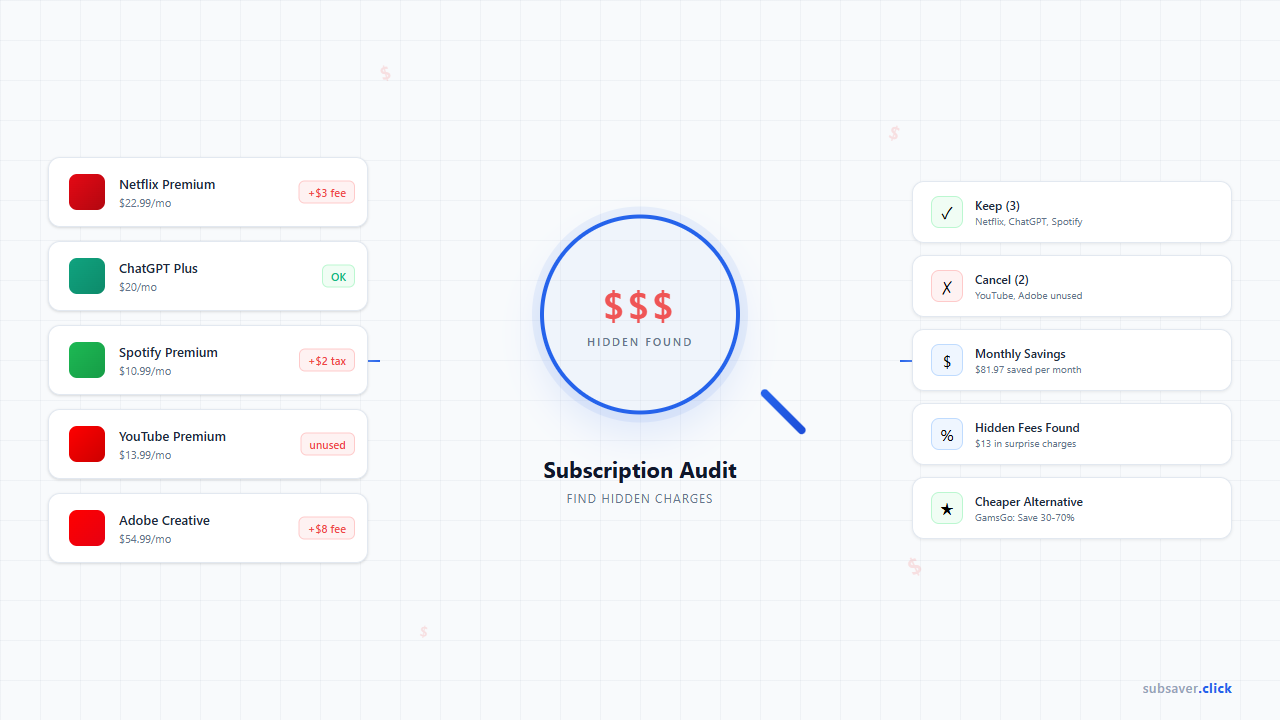
- The average American spends $273/month on subscriptions but estimates only $182 — a $91/month gap from forgotten or underused services (C+R Research, 2024).
- A subscription audit takes about 45 minutes and typically saves $50-150/month by catching zombie subscriptions, price creep, and duplicate services.
- Three methods: manual bank statement review (free, thorough), automated apps like Rocket Money or Trim ($3-12/month), or a hybrid approach using SubSaver's free calculator plus manual review.
- The biggest hidden charges come from annual renewals (forgotten gym memberships, cloud storage upgrades), family plan members who left, and services that raised prices without obvious notification.
- For subscriptions you want to keep, shared-account platforms like GamsGo (code WK2NU) can cut costs by 30-70% on services like ChatGPT Plus, Netflix, and Spotify.
Why Most People Overpay on Subscriptions
Subscription spending has a peculiar psychological property: it is almost invisible. Each charge is small enough to ignore. $9.99 here, $14.99 there, but they compound in ways that are genuinely surprising when you add them up.
C+R Research surveyed 1,006 Americans in 2024 and found the average person spends $273/month on subscriptions. When asked to estimate their spending beforehand, participants guessed $182. That $91 gap. About $1,092 per year. Comes from services people forgot they had, free trials that converted without a clear notification, and gradual price increases that went unnoticed.
A separate study from West Monroe found that 84% of people underestimate their subscription spending. The median household now carries 12 active subscriptions, up from 8 in 2022. It is not that people are careless with money. It is that subscriptions are specifically designed to be forgettable. Auto-renewal, buried cancellation flows, and round-number pricing all work against conscious spending.
None of this means subscriptions are bad. Many are genuinely worth the money. But without a periodic audit, checking what you pay, what you use, and whether better options exist. It is almost guaranteed you are overpaying on at least a few services.
Step-by-Step Subscription Audit (45 Minutes)
Block out 45 minutes. You will need access to your bank or credit card statements (last 90 days), your phone's subscription settings, and a simple spreadsheet or notes app.
Step 1: Pull Bank and Card Statements (15 minutes)
Log into every bank account and credit card you use. Search for recurring charges over the last 90 days. Annual subscriptions are easy to miss if you only check one month, three months catches most of them.
Look for these patterns:
- Charges from names you do not immediately recognize (many services bill under parent company names. "PADDLE.NET" might be your Notion subscription)
- Identical amounts repeating monthly ($9.99, $14.99, $19.99 are common subscription price points)
- Small charges you have never noticed ($0.99-$4.99 app subscriptions are the most frequently forgotten)
- Annual charges that appeared once in the last 90 days (these are the biggest blind spots)
Write down every subscription you find: service name, amount, billing frequency, and which card it charges.
Step 2: Check Phone and App Store Subscriptions (10 minutes)
iPhone: Settings → Apple ID → Subscriptions. This shows every active and recently expired subscription billed through Apple.
Android: Google Play → Payments & subscriptions → Subscriptions. Same deal, everything billed through Google Play appears here.
Amazon: Account → Memberships & Subscriptions. Prime, Audible, Kindle Unlimited, and any "Subscribe & Save" items show up here.
These three sources catch subscriptions that might not appear clearly in bank statements because they are bundled into platform charges (your $14.99 Apple charge might include three separate app subscriptions).
Step 3: Check Email for Receipts (10 minutes)
Search your email for "receipt," "subscription," "renewal," "your plan," and "billing." Sort by most recent. This catches services that bill to PayPal, gift card balances, or other payment methods not on your main cards.
Pay special attention to annual renewal notices. They often arrive with subject lines like "Your plan has been renewed" and are easy to archive without reading.
Step 4: Consolidate and Calculate (10 minutes)
Put everything in one list. Convert annual subscriptions to monthly (divide by 12). Add it all up. Most people find the total is 20-40% higher than they expected.
Use our free Subscription Savings Calculator to see your total and compare it against average spending in your category.
Where Hidden Charges Actually Hide
After auditing hundreds of subscription setups through reader feedback, these are the most common sources of wasted money:
| Hidden Charge Type | How It Happens | Typical Cost |
|---|---|---|
| Free trial conversions | Trial expires, auto-charges begin. No reminder email or buried in promotions tab | $10-30/month |
| Price creep | Service raises price $1-3/month. Notification email ignored or filtered to spam | $3-15/month across services |
| Duplicate services | Two music services, two cloud storage plans, overlapping streaming libraries | $10-25/month |
| Annual renewals | Gym, domain names, cloud storage upgraded tier, annual software licenses | $8-25/month (amortized) |
| Family plan ghosts | Paying for family plan but members have left (ex-roommates, former partners) | $5-15/month |
| Upgraded tiers you don't use | Upgraded for a one-time need (extra storage, 4K streaming) and forgot to downgrade | $5-20/month |
The family plan issue is more common than most people realize. Spotify Family costs $16.99/month for 6 accounts. If only 2 of those accounts are active, you are paying $8.50/person when the Duo plan covers 2 people for $14.99. Or individual plans at $11.99 each. Our Spotify Duo vs Family comparison breaks down exactly when each plan makes sense.
Subscription Tracking Tools Compared
| Tool | Price | Method | Best For | Limitation |
|---|---|---|---|---|
| Manual audit | Free | Bank statement review | One-time deep audit | Time-consuming, no ongoing tracking |
| Rocket Money | $3-12/month | Bank account linking + AI detection | Automatic detection and cancellation | Requires bank access, paid service (ironic for saving money) |
| Trim | Free + 33% of savings | AI negotiation + detection | Bill negotiation | Takes a cut of savings, limited outside US |
| SubSaver Calculator | Free | Manual entry + savings comparison | Visualizing total spend and finding cheaper alternatives | Manual input required, no auto-detection |
| Apple/Google built-in | Free | App store billing only | Phone app subscriptions | Only shows app store purchases, misses web subscriptions |
The honest assessment: no single tool catches everything. The most thorough approach combines a manual bank statement review (catches all charges) with your phone's built-in subscription manager (catches app store charges that may not appear clearly on statements).
The Keep-or-Cancel Framework
Once you have your list, run each subscription through three questions:
1. Have I used this in the last 30 days? If no, it is a strong cancel candidate. Services you have not touched in a month are unlikely to suddenly become essential.
2. Could I get this for free or cheaper? Many paid services have free alternatives that cover 80% of the functionality. A $10/month cloud storage plan might be unnecessary if you are only using 3GB of your 15GB free Google Drive allocation. Check our free tier comparison for AI tools specifically.
3. Is there a cheaper way to keep this? Downgrading tiers, switching to annual billing (typically 15-20% cheaper), or using shared-account services can keep access while cutting cost. For AI and streaming subscriptions, GamsGo offers legitimate shared access at 30-70% off retail. Their ChatGPT Plus slots run about $8/month versus the standard $20.
How to Reduce Costs on Subscriptions You Keep
Cancelling unused subscriptions is the obvious win. But for services you actually want, there are several ways to pay less:
- Switch to annual billing, Most services offer 15-20% discounts for annual payment. YouTube Premium drops from $13.99/month to $139.99/year ($11.67/month). Spotify Premium goes from $11.99/month to $119.99/year ($10/month).
- Student or family plans. Student discounts typically save 50%. Family plans save 40-60% per person if you actually have enough members. Use our Family Plan Calculator to check if a family plan makes sense for your household size.
- Shared-account platforms — Services like GamsGo pool subscriptions across verified users. ChatGPT Plus for ~$8/month instead of $20, Netflix Premium for ~$5 instead of $23, YouTube Premium for ~$3 instead of $14. Use code WK2NU for additional savings.
- Bundle deals. Disney+, Hulu, and ESPN+ bundle saves $8/month versus subscribing separately. Apple One bundles 4-6 services starting at $19.95/month. See our bundle deals guide for current options.
- Subscription rotation, Instead of keeping 4 streaming services year-round, keep 1-2 and rotate the others monthly based on what you want to watch. Our subscription hopping guide explains how to do this without losing your profiles or watch history.
FAQ
How often should I audit my subscriptions?
Every 3 months is the sweet spot. Quarterly audits catch new subscriptions before they become invisible, catch price increases early, and align with seasonal changes in usage (you might use a fitness app more in January than July). Set a calendar reminder.
What is the average subscription spending in 2026?
According to C+R Research, the average American spends $273/month on all subscriptions combined. This includes streaming ($61), software/apps ($29), gaming ($14), food delivery ($28), fitness ($17), and other categories. The median is lower. Around $219/month. Because high spenders pull the average up.
How do I cancel a subscription that makes it hard to cancel?
The FTC's "Click to Cancel" rule (effective since 2025) requires companies to make cancellation as easy as signup. If a service buries the cancel button or forces you to call, you can file a complaint at ftc.gov/complaint. In practice, searching "[service name] cancel subscription" usually leads to a direct cancellation link faster than navigating the app.
Are subscription sharing services legal?
Legitimate shared-account platforms like GamsGo operate by purchasing group subscriptions or family plans and distributing access to verified members. This is a gray area. It does not violate criminal law, but may technically breach some services' terms of use. The risk to individual users is minimal (account suspension at worst, not legal action), and many services tacitly tolerate it as a customer acquisition channel.
Should I use Rocket Money or similar paid subscription trackers?
It depends on how many subscriptions you have. If you carry 15+ subscriptions across multiple payment methods and struggle with manual tracking, the $3-12/month cost of Rocket Money can pay for itself quickly. For most people with under 10 subscriptions, a quarterly manual audit combined with free tools like SubSaver's calculator is sufficient.